Monday, October 20, 2014

Waves in Pipes


This is far from obvious but - the mathematics of sound waves (harmonics) in organ pipes and waves (harmonics) on a string are mathematically identical.  But here are some distinctions:

Waves on a string are TRANSVERSE - this means that the wave vibrates in a direction perpendicular to the direction of wave travel.  These are traditional looking waves.

Sound waves are LONGITUDINAL (also known as COMPRESSIONAL) - this means that the wave vibrates in a direction parallel to the direction of wave travel.  See the second set of illustrations above.

When you speak, you are oscillating the air around your mouth.  It vibrates BACK AND FORTH (not up and down).  Each air molecule vibrates the air molecules next to it and the impulse/wave travels at the speed of sound - which in room temperature dry air is around 345 m/s.

Now tubes that are open on both ends are forced to produce waves that have anti-nodes on both ends - meaning that there is nothing for the sound to bounce off of.  This is similar to strings which have nodes on both ends - something to bounce off of both ends.  In both cases, the wavelength is the same for the resonant frequency:

wavelength (for n=1) = 2L

And the sequence of harmonics is exactly the same as for strings.

Waves in tubes LOOK different than waves on strings, but they act very similarly and the mathematics are the same.

(If the tube is closed on one end, you are forced to have an anti-node on one end only.  This is trickier.  See the top 2 images of figure 1 above.)

Another image that depicts the sound in organ pipes.  Below are 6 pairs of images.  The first 3 pairs depict the waves formed in organ pipes open at both ends.  Pairs 4-6 depict the waves formed in organ pipes capped on one end.  There is a major difference with tubes capped at one end - since you are forced to have a node at one end and an antinode at the other, you only get ODD harmonics.  The wavelength is also doubled (compared to the same harmonics in tubes open at both ends).  Since the wavelengths are twice as long, the frequencies are half as much.  This means that a resonant frequency (n=1) for a tube open only on one end is half as much (one octave lower) than the same length tube open on both ends.

In other words, if you cap a tube on one end, the tone produced is one octave lower.

FYI

https://www.youtube.com/watch?v=23fTMkcDOhE&feature=youtu.be

If you missed the class on Chladni plates and resonating wire loops, etc.  Thanks to Alex M for filming this.

Also:

https://www.youtube.com/watch?v=kBmRNkM9saA


Wednesday, October 15, 2014

Music

In western music, we use an "equal tempered (or well tempered) scale."  It has a few noteworthy characteristics;

The octave is defined as a doubling (or halving) of a frequency.

You may have seen a keyboard before.  The notes are, beginning with C (the note immediately before the pair of black keys):

C
C#
D
D#
E
F
F#
G
G#
A
A#
B
C

(Yes, I could also say D-flat instead of C#, but I don't have a flat symbol on the keyboard.  And I don't want to split hairs over sharps and flats - it's not that important at the moment.)

There are 13 notes here, but only 12 "jumps" to go from C to the next C above it (one octave higher).  Here's the problem.  If there are 12 jumps to get to a factor of 2 (in frequency), making an octave, how do you get from one note to the next note on the piano?  (This is called a "half-step" or "semi-tone".)

The well-tempered scale says that each note has a frequency equal to a particular number multiplied by the frequency that comes before it.  In other words, to go from C to C#, multiply the frequency of the C by a particular number.

So, what is this number?  Well, it's the number that, when multiplied by itself 12 times, will give 2.  In other words, it's the 12th root of 2 - or 2 to the 1/12 power.  That is around 1.0594.

So to go from one note to the next note on the piano or fretboard, multiply the first note by 1.0594.  To go TWO semi-tones up, multiply by 1.0594 again - or multiply the first note by 1.0594^2.  Got it?


Monday, October 13, 2014

Wave problems 1

1.  Differentiate between mechanical and electromagnetic waves.  Give examples.

2.  Draw a wave and identify the primary parts (wavelength, crest, trough, amplitude).

3.  Find the speed of a 500 Hz wave with a wavelength of 0.4 m.

4.  What is the frequency of a wave that travels at 24 m/s, if 3 full waves fit in a 12-m space?  (Hint:  find the wavelength first.)

5.  Approximately how much greater is the speed of light than the speed of sound?

6.  Harmonics

a.  Draw the first 3 harmonics for a wave on a string.
b.  If the length of the string is 1-m, find the wavelengths of these harmonics.
c.  If the frequency of the first harmonic (n = 1) is 10 Hz, find the frequencies of the next 2 harmonics.
d.  Find the speeds of the 3 harmonics.  Notice a trend?

7.  Show how to compute the wavelength of WTMD's signal (89.7 MHz).  Note that MHz means 'million Hz."

8.  A C-note vibrates at 262 Hz (approximately).  Find the frequencies of the next 2 C's (1 and 2 octaves above this one).

>

(answers)

1, 2.  See notes.

3.  200 m/s

4.  wavelength is 4 m.  Frequency is 6 Hz.

5.  3,000,000 / 340 --- that's around a million to one ratio

6.
a.  see notes
b.  wavelengths are:  2 m, 1 m, and 2/3 m
c.  frequencies are 10, 20 and 30 Hz, respectively, for n = 1, 2 and 3
d.  speeds are all constant:  20 m/s

7.  speed of light divided by 89.7 MHz.  That is 300,000,000 / 89,700,000, which works out to around 3.3 m.


8.  524 Hz and 1048 Hz

Wednesday, October 8, 2014

Energy

I stole my energy story from the famous American physicist Richard Feynman. Here is a version adapted from his original energy story. He used the character, "Dennis the Menace." The story below is paraphrased from the original Feynman lecture on physics (in the early 1960s).

Dennis the Menace
Adapted from Richard Feynman
Imagine Dennis has 28 blocks, which are all the same. They are absolutely indestructible and cannot be divided into pieces.
His mother puts him and his 28 blocks into a room at the beginning of the day. At the end of each day, being curious, she counts them and discovers a phenomenal law. No matter what he does with the blocks, there are always 28 remaining.
This continues for some time until one day she only counts 27, but with a little searching she discovers one under a rug. She realises she must be careful to look everywhere.
One day later she can only find 26. She looks everywhere in the room, but cannot find them. Then she realises the window is open and two blocks are found outside in the garden.
Another day, she discovers 30 blocks. This causes considerable dismay until she realises that Bruce has visited that day, and left a few of his own blocks behind.
Dennis' mother removes the extra blocks, gives the remaining ones back to Bruce, and all returns to normal.
We can think about energy in this way (except there are no blocks!). We can use this idea to track energy transfers during changes. We need to be careful to look everywhere to ensure that we can account for all of the energy.

Some ideas about energy
  • Energy is stored in fuels (chemicals).
  • Energy can be stored by lifting objects (potential energy).
  • Moving objects carry energy (kinetic energy).
  • Electric current carries energy.
  • Light (and other forms of radiation) carries energy.
  • Heat carries energy.
  • Sound carries energy.

But is energy a real thing?  No, not exactly.  It is a mathematical concept, completely consistent with Newton's laws and the equations of motion.  It allows us to see that some number (calculated according to other manifest changes - speed, mass, temperature, position, etc.) remains constant before and after some "event" occurs.

Waves!


So - Waves.....  

We spoke about energy.  Energy can, as it turns out, travel in waves.  In fact, you can think of a wave as a traveling disturbance, capable of carrying energy.

There are several wave characteristics (applicable to most conventional waves) that are useful to know:

amplitude - the "height" of the wave, from equilibrium (or direction axis of travel) to maximum position above or below

crest - peak (or highest point) of a wave

trough - valley (or lowest point) of a wave

wavelength (lambda - see picture 2 above) - the length of a complete wave, measured from crest to crest or trough to trough (or distance between any two points that are in phase - see picture 2 above).  Measured in meters (or any units of length).

frequency (f) - literally, the number of complete waves per second.  The unit is the cycle per second, usually called:  hertz (Hz)

wave speed (v) -  the rate at which the wave travels.  Same as regular speed/velocity, and measured in units of m/s (or any unit of velocity).  It can be calculated using a simple expression:


There are 2 primary categories of waves:

Mechanical – these require a medium (e.g., sound, guitar strings, water, etc.)

Electromagnetic – these do NOT require a medium and, in fact, travel fastest where is there is nothing in the way (a vacuum). All e/m waves travel at the same speed in a vacuum (c, the speed of light):

c = 3 x 10^8 m/s

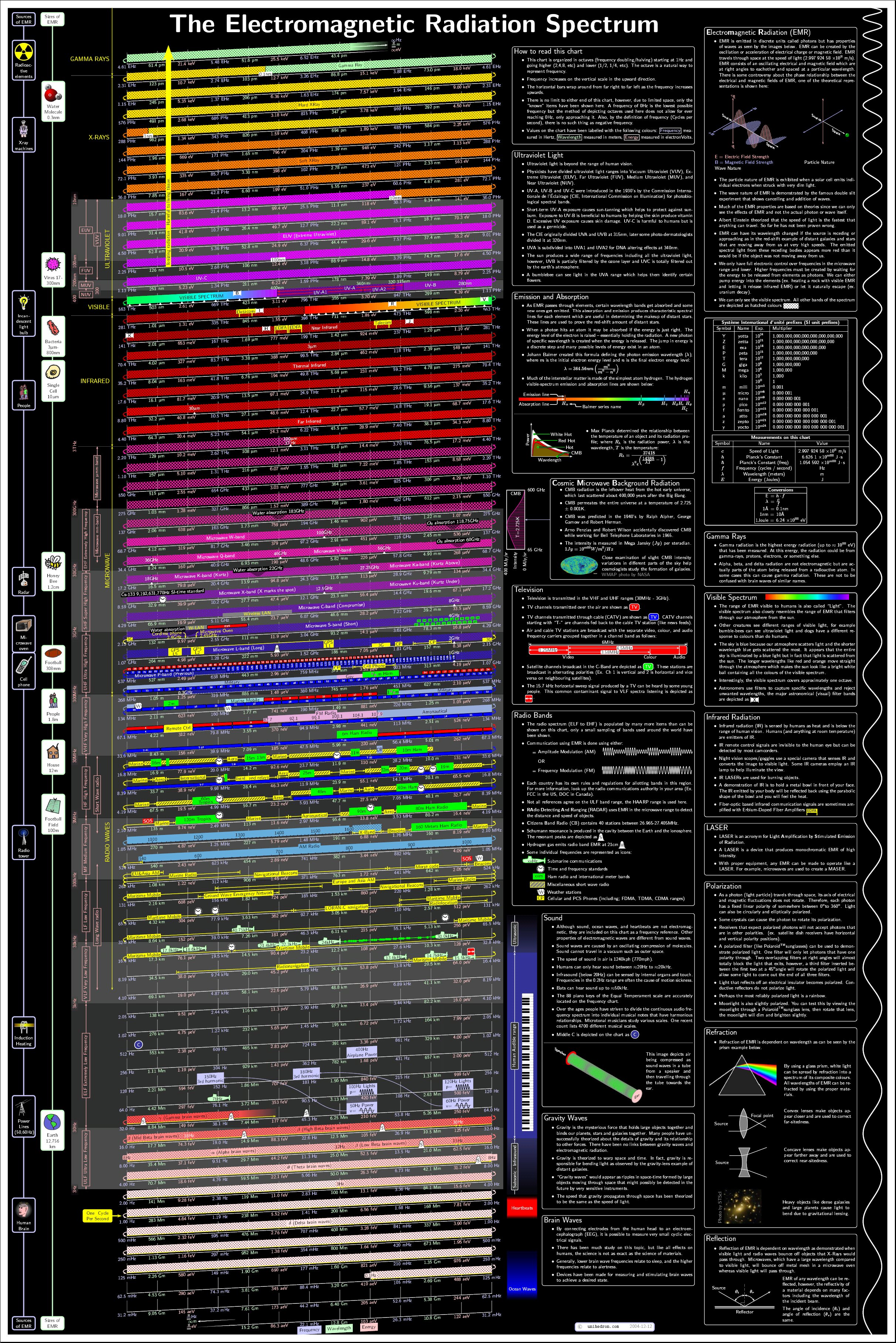
First, the electromagnetic (e/m) waves:

General breakdown of e/m waves from low frequency (and long wavelength) to high frequency (and short wavelength):

Radio
Microwave
IR (infrared)
Visible (ROYGBV)
UV (ultraviolet)
X-rays
Gamma rays

In detail, particularly the last image:


http://www.unihedron.com/projects/spectrum/downloads/full_spectrum.jpg

Mechanical waves include:  sound, water, earthquakes, strings (guitar, piano, etc.)....

Again, don't forget that the primary wave variables are related by the expression:

v = f l


speed = frequency x wavelength

(Note that 'l' should be the Greek symbol 'lambda', if it does not already show up as such.)

For e/m waves, the speed is the speed of light, so the expression becomes:

c = f l


Note that for a given medium (constant speed), as the frequency increases, the wavelength decreases.

Next up - Sound!