Wednesday, October 29, 2014

Optics HW -1


3.  Review the concept of refraction:  what it is, what causes it, what happens during it, under what circumstances does light bend, etc.  Review also reflection and basics of mirrors.

4.  Show how to calculate the wavelength of WTMD's signal (89.7 MHz).

5.  Review the concept of total internal reflection (and its relation to fiber optics).

Monday, October 27, 2014

Light - 2. Reflection and Refraction.


Reflection - light "bouncing" off a reflective surface. This obeys a simple law, the law of reflection!

The incident (incoming) angle equals the reflected angle. Angles are generally measured with respect to a "normal" line (line perpendicular to the surface).

Note that this works for curved mirrors as well, though we must think of a the surface as a series of flat surfaces - in this way, we can see that the light can reflect in a different direction, depending on where it hits the surface of the curved mirror. More to come here.


Refraction:


Refraction is much different. In refraction, light enters a NEW medium. In the new medium, the speed changes. We define the extent to which this new medium changes the speed by a simple ratio, the index of refraction:
n = c/v
In this equation, n is the index of refraction (a number always 1 or greater), c is the speed of light (in a vacuum) and v is the speed of light in the new medium.
The index of refraction for some familiar substances:
vacuum, defined as 1
air, approximately 1
water, 1.33
glass, 1.5
polycarbonate ("high index" lenses), 1.67
diamond, 2.2
The index of refraction is a way of expressing how optically dense a medium is. The actual index of refraction (other than in a vacuum) depends on the incoming wavelength. Different wavelengths have slightly different speeds in (non-vacuum) mediums. For example, red slows down by a certain amount, but violet slows down by a slightly lower amount - meaning that red light goes through a material (glass, for example) a bit faster than violet light. Red light exits first.
In addition, different wavelengths of light are "bent" by slightly different amounts. This is trickier to see. We will explore it soon.


Refraction, in gross gory detail


Consider a wave hitting a new medium - one in which is travels more slowly. This would be like light going from air into water. The light has a certain frequency (which is unchangeable, since its set by whatever atomic process causes it to be emitted). The wavelength has a certain amount set by the equation, c = f l, where l is the wavelength (Greek symbol, lambda).
When the wave enters the new medium it is slowed - the speed becomes lower, but the frequency is fixed. Therefore, the wavelength becomes smaller (in a more dense medium).
Note also that the wave becomes "bent." Look at the image above: in order for the wave front to stay together, part of the wave front is slowed before the remaining part of it hits the surface. This necessarily results in a bend.
The general rule - if a wave is going from a lower density medium to one of higher density, the wave is refracted TOWARD the normal (perpendicular to surface) line. See picture above.


http://stwww.weizmann.ac.il/lasers/laserweb/java/twoangles2.htm

http://lectureonline.cl.msu.edu/~mmp/kap25/Snell/app.htm

http://www.physics.uoguelph.ca/applets/Intro_physics/refraction/LightRefract.html

Light - 1

Recall that waves can be categorized into two major divisions:

Mechanical waves, which require a medium. These include sound, water and waves on a (guitar, etc.) string

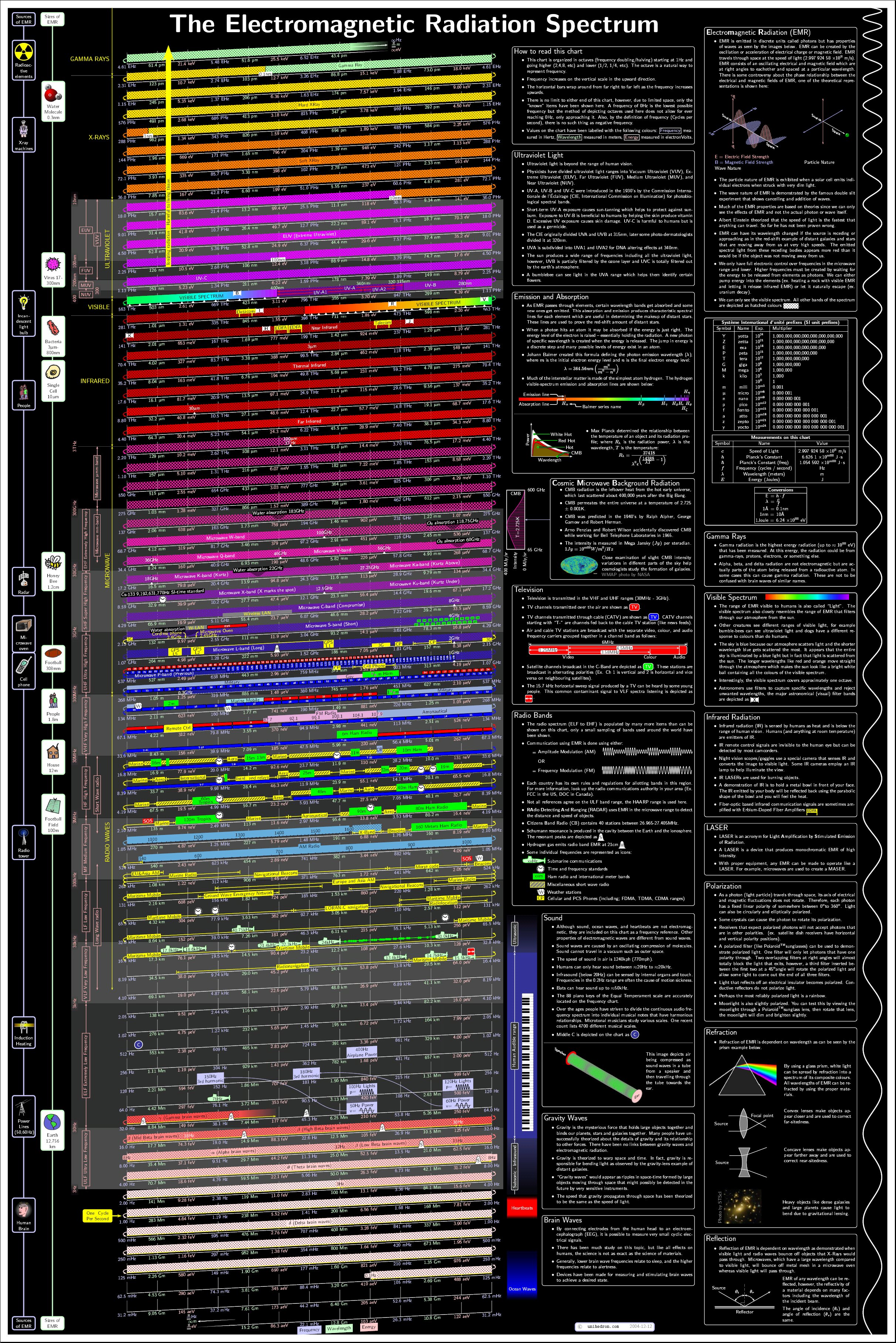
Electromagnetic waves, which travel best where there is NO medium (vacuum), though they can typically travel through a medium as well. All electromagnetic waves can be represented on a chart, usually going from low frequency (radio waves) to high frequency (gamma rays). This translates to: long wavelength to short wavelength.

All of these EM waves travel at the same speed in a vacuum: the speed of light (c). Thus, the standard wave velocity equation becomes:


c = f l


where c is the speed of light (3 x 10^8 m/s), f is frequency (in Hz) and l (which should actually be the Greek letter, lambda) is wavelength (in m).

General breakdown of e/m waves from low frequency (and long wavelength) to high frequency (and short wavelength):

Radio
Microwave
IR (infrared)
Visible (ROYGBV)
UV (ultraviolet)
X-rays
Gamma rays

In detail, particularly the last image:


http://www.unihedron.com/projects/spectrum/downloads/full_spectrum.jpg

Don't forget - electromagnetic waves should be distinguished from mechanical waves (sound, water, earthquakes, strings on a guitar/piano/etc.). 

ALL E/M waves (in a vacuum) travel at the SPEED OF LIGHT (c).


Wednesday, October 22, 2014

Practice questions in music

Consider the musical note G, 392 Hz.  Find the following:

1.  The frequencies of the next two G's, one and two octaves above.

2.  The frequency of the G one octave lower than 392 Hz.

3.  The frequency of G#, one semi-tone (piano key or guitar fret) above this G.

4.  The frequency of A#, 3 semi-tones above G.

5.  The wavelength of the 392 Hz sound wave, assuming that the speed of sound is 340 m/s.

6.  Review the notes on the Doppler effect - be able to explain it, and know how it applies to sound and light waves.

7.  What are the differences between longitudinal and transverse waves?  Gives examples of each.  What type of wave is sound?


Also for your consideration.  Understand the following concepts:

a.  harmonics on a string

b.  how waves form in a tube - what actually happens with the air inside?

c.  Here's a thought question for you - why does breathing in helium make your voice higher?

answers:

1.  392 x 2; 392 x 4

2.  392/2

3.  392 x 1.0594

4.  392 x 1.0594 x 1.0594 x 1.0594  (or 392 x 1.0594^3)

5.  340/392

6-7.  See notes.

Doppler Effect!


http://www.lon-capa.org/~mmp/applist/doppler/d.htm

http://falstad.com/mathphysics.html
Run the Ripple tank applet -
http://falstad.com/ripple/

The key in the Doppler effect is that motion makes the "detected" or "perceived" frequencies higher or lower.

If the source is moving toward you, you detect/measure a higher frequency - this is called a BLUE SHIFT.

If the source is moving away from you, you detect/measure a lower frequency - this is called a RED SHIFT. Distant galaxies in the universe are moving away from us, as determined by their red shifts. This indicates that the universe is indeed expanding (first shown by E. Hubble). The 2011 Nobel Prize in Physics went to local physicist Adam Riess (and 2 others) for the discovery of the accelerating expansion of the universe. Awesome stuff!

http://www.nobelprize.org/nobel_prizes/physics/laureates/2011/

It's worth noting that the effect also works in reverse. If you (the detector) move toward a sound-emitter, you'll detect a higher frequency. If you move away from a detector move away from a sound-emitter, you'll detect a lower frequency.

Mind you, these Doppler effects only happen WHILE there is relative motion between source and detector (you).

And they also work for light. In fact, the terms red shift and blue shift refer mainly to light (or other electromagnetic) phenomena.

Monday, October 20, 2014

Waves in Pipes


This is far from obvious but - the mathematics of sound waves (harmonics) in organ pipes and waves (harmonics) on a string are mathematically identical.  But here are some distinctions:

Waves on a string are TRANSVERSE - this means that the wave vibrates in a direction perpendicular to the direction of wave travel.  These are traditional looking waves.

Sound waves are LONGITUDINAL (also known as COMPRESSIONAL) - this means that the wave vibrates in a direction parallel to the direction of wave travel.  See the second set of illustrations above.

When you speak, you are oscillating the air around your mouth.  It vibrates BACK AND FORTH (not up and down).  Each air molecule vibrates the air molecules next to it and the impulse/wave travels at the speed of sound - which in room temperature dry air is around 345 m/s.

Now tubes that are open on both ends are forced to produce waves that have anti-nodes on both ends - meaning that there is nothing for the sound to bounce off of.  This is similar to strings which have nodes on both ends - something to bounce off of both ends.  In both cases, the wavelength is the same for the resonant frequency:

wavelength (for n=1) = 2L

And the sequence of harmonics is exactly the same as for strings.

Waves in tubes LOOK different than waves on strings, but they act very similarly and the mathematics are the same.

(If the tube is closed on one end, you are forced to have an anti-node on one end only.  This is trickier.  See the top 2 images of figure 1 above.)

Another image that depicts the sound in organ pipes.  Below are 6 pairs of images.  The first 3 pairs depict the waves formed in organ pipes open at both ends.  Pairs 4-6 depict the waves formed in organ pipes capped on one end.  There is a major difference with tubes capped at one end - since you are forced to have a node at one end and an antinode at the other, you only get ODD harmonics.  The wavelength is also doubled (compared to the same harmonics in tubes open at both ends).  Since the wavelengths are twice as long, the frequencies are half as much.  This means that a resonant frequency (n=1) for a tube open only on one end is half as much (one octave lower) than the same length tube open on both ends.

In other words, if you cap a tube on one end, the tone produced is one octave lower.

FYI

https://www.youtube.com/watch?v=23fTMkcDOhE&feature=youtu.be

If you missed the class on Chladni plates and resonating wire loops, etc.  Thanks to Alex M for filming this.

Also:

https://www.youtube.com/watch?v=kBmRNkM9saA